InnerSource: Governance You Can Query
Every organisation that solves discovery quietly inherits a harder problem: knowing which of the things it found are still true. The entry for a dead library looks exactly like the entry for one three teams depend on in production, and the difference never announces itself. The answer is to stop recording governance in documents and minutes, and start recording it in typed fields that machines can check. Discovery told you what you have. Curation tells you what you can still depend on.
The catalogue that lies
Last time I argued that InnerSource is the nervous system of the octopus organisation, and I closed by claiming that what separates companies which compound knowledge from companies which silo it is governance rather than tooling. That claim deserved more than a closing line.
Start with the number. Volvo Group consolidated more than 3,600 APIs into a single internal catalogue that nobody had previously been able to search. That was the win. The question arrives the following Monday, and it is not a technology question at all. Which of those 3,600 still work? Nothing in a catalogue answers that by default. The entry for a library abandoned eighteen months ago is rendered in the same font, with the same confidence, as the entry for the one three teams are depending on this morning.
Resistance is rarely the obstacle. Engineers share readily when sharing is easy. The obstacle is the review board: the quarterly meeting where the state of an asset gets recorded in minutes, and where it then proceeds to quietly stop being true. An owner leaves in March. A README describes a version that no longer ships. Someone renames a repository and the documentation never notices. Governance recorded in prose decays from the moment the meeting ends, because prose is write-once and the world is not.
The damage is specific. One entry that looks authoritative but is dead costs more trust than ten missing entries, because a gap teaches a developer to look elsewhere once while a lie teaches them to stop looking altogether. Within a quarter they are back in Slack or Teams, asking whether anyone knows if we already built something for this, which is precisely where the programme started.
“A catalogue nobody trusts is worse than no catalogue at all. It burns the one currency reuse runs on.”
A field, not a minute
Here is the distinction that matters, and it turns out to be a data modelling decision rather than a cultural one.
Governance that works records asset state as something a machine can evaluate: a typed, enumerated value that sits in the repository beside the code. In Backstage’s descriptor file that is spec.lifecycle, and it accepts three values (or you define your own states). Experimental, production, deprecated. No free text, no adjectives, no allowances. The consequence is the entire point. A machine can branch on an enumerated value, and no human can quietly disagree with one.
That single field then propagates outward without anyone maintaining it. It decides whether a deprecation banner renders for whoever opens the entry, whether the asset surfaces in search at all, whether it may be offered as a certified scaffolding template, and how strict the required checks are on its own pull requests.
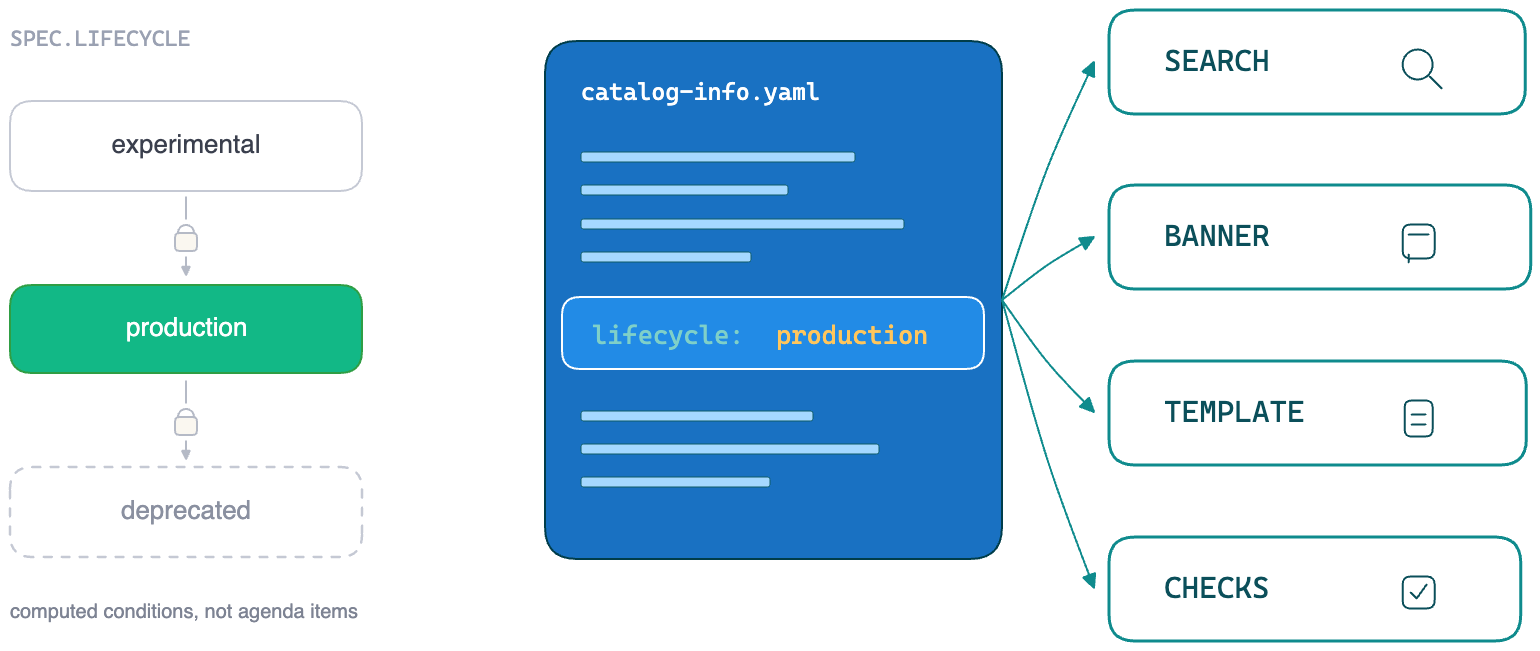
Transitions stop being agenda items. An asset is promoted when its ownership, documentation and freshness checks all pass. It becomes a candidate for retirement when freshness has failed for several cycles and the dependency graph reports zero active consumers. A person still signs off that retirement, deliberately, but nobody has to notice the condition first.
Which brings us to the pruning, because a nervous system that only adds connections does not get cleverer. A human brain reaches its adult complement of synapses at around two years old and then spends the following decade cutting roughly half of them away. What survives is what carries signal. An octopus arm that has lost its connection to the centre does not announce the fact; it simply stops answering. Governance in a mature InnerSource programme is exactly that pruning function. It exists so that every dependency the organisation believes it has is a dependency that still responds when called.
“Every transition is triggered by a computed condition, not a status meeting.”
Gates, ranks, and one forbidden field
Four mechanics survive contact with real organisations.
Publish governance as a menu rather than a mandate. Three levels, chosen at launch and displayed in the catalogue entry itself. Open, where everyone can read and nobody expects outside contributions. Reviewed, where outside pull requests are welcome and the owning team merges. Shared stewardship, where proven contributors from other teams hold merge rights. Three is enough. A consumer learns what they are adopting, and a maintainer can decline a contribution without it reading as hostility.
Make every gate pass or fail inside a pipeline. Nothing enters the catalogue without an owner, documentation and a licence, validated in the same pull request that adds the code, and configured as a required status check rather than an advisory job. A reviewer should never be the thing that catches a missing owner field.
Let the maturity ladder gate visibility. Only the top rank gets recommended in search and offered as a certified template. A badge nobody acts on is decoration. A badge that decides whether anyone finds you is an incentive.
And the fourth, which is worth more than the other three: the owner field must name a team, never a person. It is the most common way a catalogue decays, because the entry does not break when someone leaves. It simply starts lying.
Measure five things and stop there. Reuse, counted as distinct consumers. Freshness, judged against the support tier the asset claims, so experimental work may be quiet and production work may not. Cross-team contributions merged, the honest test of whether InnerSource is happening or whether you have a normal repository with a generous README. Defects traced to the asset, normalised per consumer. And catalogue accuracy, the share of entries with a valid, current, re-attested owner. That last number is the canary. When it drops, the other four are fiction.
The catalogue has a new reader
One claim from the last piece deserves a second pass: that AI accelerates the cost of siloed knowledge faster than almost anything else. There is a sharper version of it now.
AI agents read your catalogue literally. A stale entry used to cost one engineer an afternoon of confusion. Today the same entry gets retrieved by an assistant that scaffolds services or advises teams on retries, and it becomes a confidently wrong answer delivered at machine speed to people who will never open the repository. Metadata quality used to be a developer experience concern. It is now the ground truth layer beneath every internal AI tool anyone is about to build.
The organisations that fail here will not fail loudly. They will simply discover, some quarter later, that nothing was ever pruned, and that an unpruned network is not a source of intelligence. It is noise with good documentation.
What survives the pruning
Sovereignty, where this series began, turns out to mean rather less about ownership than about knowing which of your assets you can still depend on. A dependency you cannot verify remains a dependency; it is simply one you have stopped looking at.
The companies that compound knowledge will not be the ones holding the largest catalogue. They will be the ones whose catalogue is small enough to be true.
The octopus reaches. It also lets go of what it can no longer feel.